"I tend to believe that scientific knowledge has fractal properties; that no matter what we learn, what remains, however small it may seem, is just as infinitely complex as the whole was to begin with. This, I think, is the secret of the Universe."
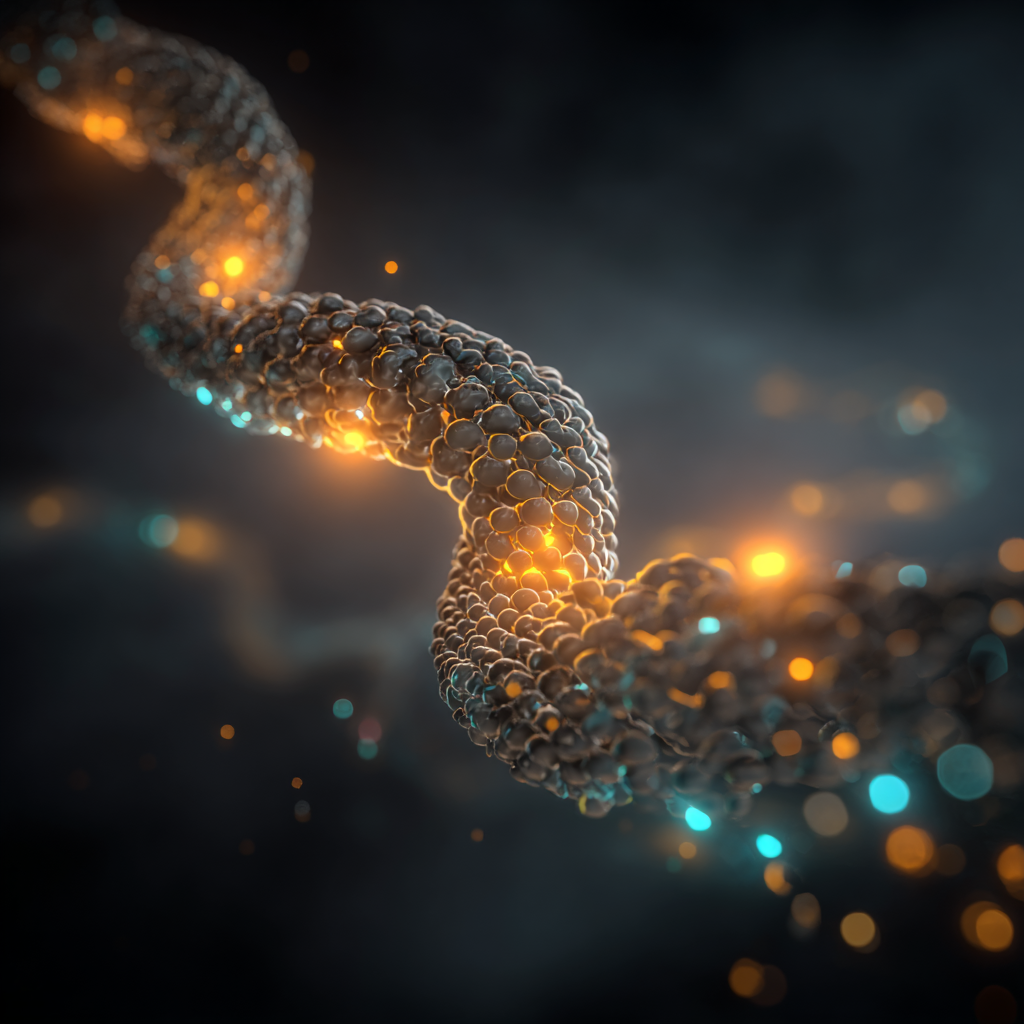
Artistic visualization of the studied system
Fun fact: don't be fooled by the artistic vision. These tiny motors work at over 100 steps per second, which would correspond to 360 km/h if we, as humans, walked at 100 steps per second.
The Research
Cells have internal highways called microtubules. Tiny motor proteins walk along them at incredible speeds — the equivalent of 200 km/h. I built kinetic Monte Carlo simulations to understand how this walking affects the highway's stability, in collaboration with CEA Grenoble biologists.
Coming Soon 2026
A methodology paper on efficient kinetic Monte Carlo simulations
Documenting a significant performance breakthrough achieved during this research